Networks over globe

Managed SD-WAN

Intelligent, Secure, and Resilient Networking for the AI-ready Enterprise

Your business depends on reliable, high-performance network connectivity to stay agile, keep employees productive, and ensure customers can seamlessly connect with your teams.​ Hughes Managed SD-WAN routes every interaction with intelligent network traffic management, integrated security, proactive monitoring, and centralized support 24/7 from a trusted provider.

The result? A secure, resilient, and AI-ready network that adapts to your changing business needs.​

Why Enterprises Need SD-WAN​

Today’s enterprise relies on always-on connectivity to keep business flowing, applications accessible, and customers connected. Even a brief network disruption can affect revenue, interrupt critical operations, and compromise customer experiences.​

As businesses accelerate digital transformation, AI readiness, support distributed workforces, connect more IoT devices, and shift applications to the cloud, traditional wide area network (WAN) architectures no longer work.​

Distributed organizations face increased network complexity as branch locations rely on different infrastructure, performance levels, and connectivity options such as fiber, cable, 4G/5G wireless, and satellite services. These variations can create bottlenecks, degrade application performance, and drive up network management costs and complexity.​

​For IT teams, delivering fast, secure, and reliable connectivity across every location is an ongoing challenge. A resilient, high-performance network is essential to keeping business operations running smoothly, enabling agility, and maintaining a competitive edge.​

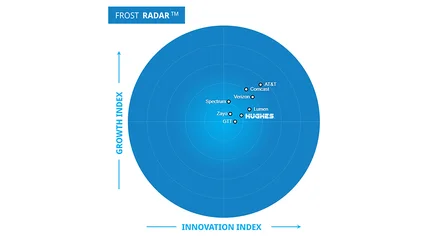
Hughes Recognized as a Leader in Managed SD-WAN Services by Frost & Sullivan​

Frost Radar

What is Hughes Managed SD-WAN?

Hughes Managed SD-WAN (Software-Defined Wide Area Network) is a next-generation networking solution that brings together wired, wireless, and satellite connectivity to help organizations optimize performance, reduce operational complexity, and better manage underlying infrastructure costs.​

SD-WAN simplifies the management of distributed wide area networks (WANs) through centralized control, intelligent traffic routing, and enhanced network visibility.​

​As a trusted managed service provider, Hughes designs, integrates, and manages the entire network, transforming standard broadband connections into reliable, high-performance, enterprise-grade WANs.

Connection lines on road

Powering a Smarter, More Resilient Network​

Glowing network lines connecting across Earth at sunrise from space.

Multi-Transport WAN Modernization​

  • Modern Multi-Transport and Multi-Orbit Connectivity​
  • ​Intelligent, Flexible, Resilient Traffic Management​
  • ​Integrated SASE and Zero Trust Security​
Hands typing on a laptop beneath a glowing blue AI microchip icon.

AI-Driven Operational Simplicity​

  • AIOps with AI-driven Root Cause Analysis and Autonomous Remediation
  • ​Zero Touch Provisioning and Scalable Orchestration​
  • ​Real-Time Analytics and API-Driven Visibility​
Two colleagues collaborating over a laptop in a modern office.

Outcome-Focused Fully Managed​

  • Consultative, Service-First, Outcome-Focused Approach
  • Comprehensive, Open Ecosystem of Leading Technology​
  • Enterprise-Grade Service Delivery and Global Support​

Benefits of Hughes Managed SD-WAN​

Reduce Costs and Risk​

Enterprises can reduce risk and optimize for resilience, performance, and costs by implementing a broad range of transport options including fiber, cable, 5G, and GEO/LEO satellite. Network administrators can prioritize business-critical applications and intelligently direct traffic over the most appropriate network paths to optimize performance, cost, and reliability.​

Optimize Network Performance​

Hughes AIOps capabilities support predictive monitoring and automated root cause analysis, resulting in proactive remediation and less reliance on manual operations. This predictive operating model enables faster issue resolution, improved network performance, and greater operational efficiency.​

Enable AI-Ready Network Connectivity

Hughes Managed SD-WAN supports AI and agentic-AI applications through application-aware routing, bidirectional capacity, resilient connectivity, segmentation, and visibility across branches, clouds, APIs, data sources, and AI services.

Strengthen Security​

With SD-WAN, underlay, overlay, and security is unified into a single, centrally managed experience. This enables secure, high-performance WANs and consistent end-to-end security policy enforcement across the enterprise, without the limitations of traditional box-by-box management.​

Simplify Management ​

​SD-WAN simplifies complex network environments while giving IT teams greater visibility and control. The HughesON Portal and PULSE platform provide a unified operational view across sites, devices, and services, with real-time telemetry, triage insights, remediation support, and API integration into enterprise IT environments.​

Improve IT Staff Efficiency​

SD-WAN simplifies network management by enabling IT teams to configure, monitor, and troubleshoot network infrastructure remotely, reducing the need for costly on-site visits. This streamlines operations, lowers management costs, and allows organizations to make more efficient use of existing IT resources.​

Interested in SD-WAN solutions around the world?​

Discover our solutions in Europe, Brazil, India, and Latin America.

Why Hughes?

Industry Recognition
Scale and Experience
Differentiators
Open Ecosystem

Industry Recognition

Proven Scale. Decades of Experience.

  • 50+ years of managed services experience delivering and supporting complex enterprise networks.
  • Deep SD-WAN expertise spanning network connectivity, performance optimization, and reliability.
  • Proven global scale: More than 120,000 SD-WAN sites rely on Hughes for network management and support.
  • Broad industry experience serving enterprises across retail, restaurants, hospitality, financial services, and government.

What Sets Hughes Managed SD-WAN Apart?

  • Service-first Model Designed Around Outcomes: Business outcomes come first, with a service model tailored to each customer’s unique needs
  • Multi-Transport and Multi-Orbit Connectivity: Flexible transport options across fiber, cable, 5G, and GEO/LEO satellite
  • Integrated SASE and Zero Trust Security: Robust built-in security with a flexible path to SASE and Zero Trust
  • AIOps with AI-driven Root Cause Analysis and Autonomous Remediation: AI-powered tools for proactive operations, issue detection, and faster resolution
  • Real-Time Analytics and API-Driven Visibility: Real-time insights and API integrations for greater network visibility and control

Hughes Empowers Customers with Flexibility and Choice

Our Managed SD-WAN solution supports a broad ecosystem of partner technologies and connectivity options including fiber, cable, 5G, and GEO/LEO satellite, enabling customers to balance network resilience, performance, and cost based on their unique needs.

Our vendor-agnostic approach provides flexibility in cloud-delivered security and integration with SSE and SASE solutions, giving customers the freedom to evolve toward Zero Trust and Managed SASE at their own pace—without being locked into a single technology or approach.
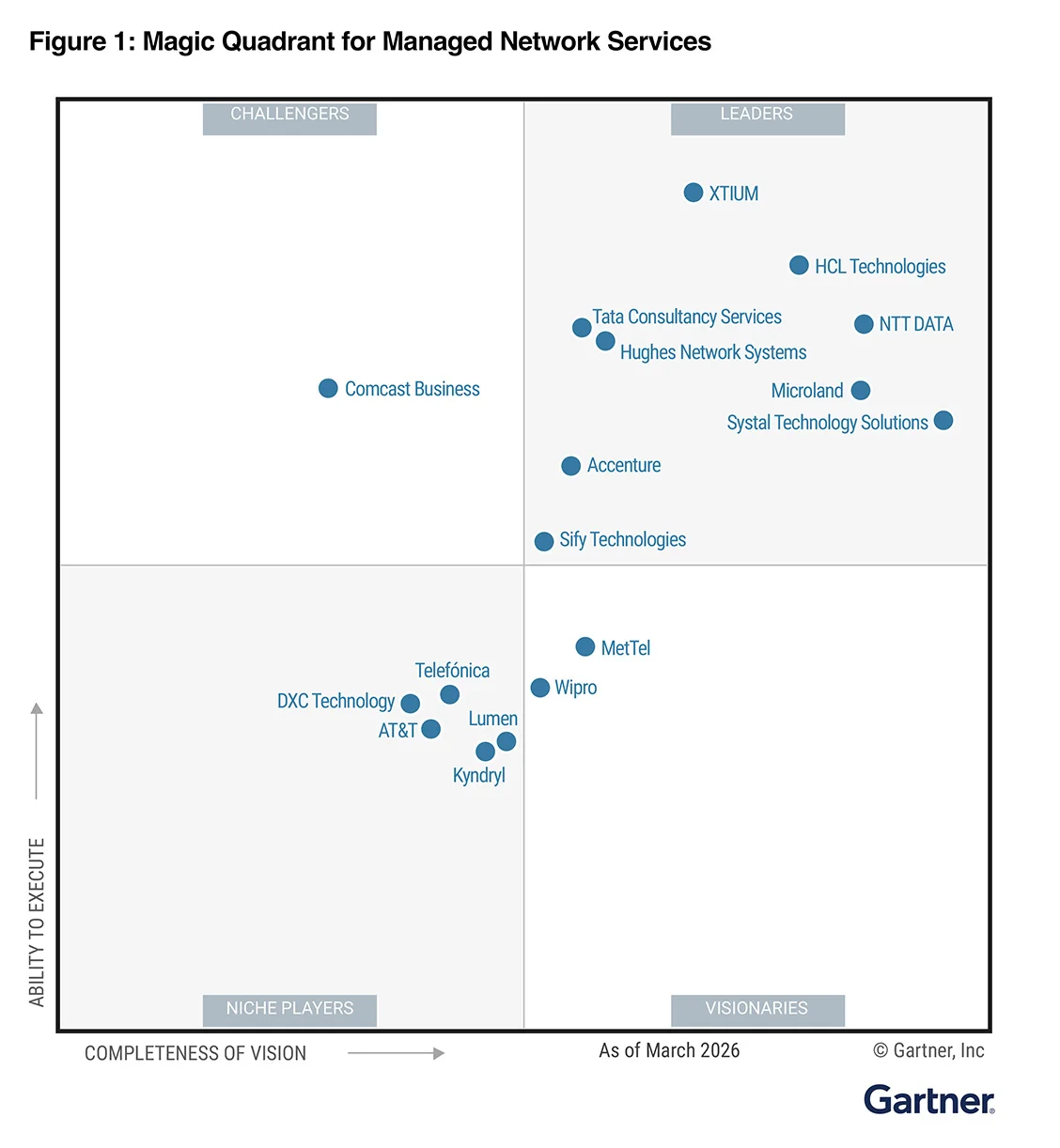

Gartner Magic Quadrant 2026
Three colleagues collaborating over a laptop in an office meeting room.
Glowing blue digital globe overlaid with futuristic data interfaces.
Glowing blue network lines overlaying a modern city skyline by the water at night.

Bring Network and Security Together

Distributed enterprises are adopting SD-WAN alongside Secure Service Edge (SSE) capabilities to unify network connectivity and security management.

This approach is part of a modern architecture known as Secure Access Service Edge (SASE), which converges networking and security services within a single, cloud-delivered framework.

By centralizing management and policy enforcement, SASE helps organizations reduce operational complexity, improve visibility, and lower the costs associated with managing separate network and security solutions.

Benefits of Hughes Managed SASE:

Stronger Security
Simplify administration, improve visibility, and support consistent policy enforcement across distributed locations and users by unifying network and security.

Greater Operational Efficiency
Reduce reliance on siloed tools and management consoles. Centralized visibility helps IT teams streamline troubleshooting, identify issues faster, and simplify day-to-day operations.

Lower Total Cost of Ownership
Reduce dependence on physical security and networking appliances by shifting to cloud-based services. This can lower capital expenditures (CapEx) and ongoing expenses associated with periodic hardware refreshes.

Best-in-Class Partnerships

Hughes partners with industry-recognized SD-WAN leaders such as Fortinet, Cisco Meraki, Arista, Ericsson Enterprise, and Netskope, enhancing our ability to deliver secure SD-WAN solutions for distributed, cloud-centric enterprises. Learn More.


Fortinet logo
Cisco Meraki logo
ARISTA logo
Ericsson
netshope logo

Frequently Asked Questions

What is managed SD-WAN?

Managed SD-WAN is a networking solution that brings together wired, wireless, and satellite connectivity to help organizations intelligently connect branch locations to data centers and the cloud, while optimizing performance, reducing operational complexity, and better managing underlying infrastructure costs.​

SD-WAN enables distributed businesses to design, provision, deploy, and manage their WANs across thousands of sites from a centralized cloud-based dashboard.​ Key capabilities of SD-WAN include intelligent traffic routing based on business intent, metrics, and policies, improved application performance and resiliency, and enhanced security.

What problems does SD-WAN solve for enterprises?

Using traditional MPLS to connect offices to corporate headquarters is reliable but expensive, has limited bandwidth which impacts performance, isn’t designed for cloud, and is rigid to deploy. This results in latency, slow application performance, and frustrated user experiences that ultimately impact workforce productivity and customer satisfaction.

SD-WAN helps reduce equipment sprawl and total cost of ownership (TCO). The high cost of owning and managing hardware from different vendors is inefficient, expensive, and impacts IT staff productivity. Manual site-by-site configuration is also inefficient and leads to policy gaps and higher security risk.

How is managed SD-WAN different from traditional WAN?

Managed SD-WAN provides greater flexibility, centralized control, and more intelligent traffic management than traditional WAN architectures, while reducing the operational burden on IT teams.

Traditional WAN architectures rely heavily on physical network hardware, dedicated private circuits, and static routing. Network configurations, connectivity, and security policies are programmed into individual devices, often through command-line interfaces. As a result, making changes across multiple locations can be time-consuming and require hands-on configuration at each endpoint.

SD-WAN uses a software overlay and centralized management to simplify network operations and provide greater agility. Through a centralized controller, IT teams can manage multiple network connections, configure policies, and make changes across locations without having to program each device individually.

SD-WAN also offers more dynamic traffic management. It can intelligently route application traffic across available connections based on predefined policies, application requirements, and changing network conditions. Bandwidth and network resources can be adjusted as demands evolve, helping optimize application performance and reliability. Whereas traditional WANs require manual configuration and intervention to accommodate changing traffic patterns.

What are the most important business benefits of SD-WAN?

Business continuity: As businesses become more distributed, SD-WAN keeps employees, locations, and cloud applications reliably connected with resilient, high-performance networking that supports today’s distributed business environments.

Network performance: SD-WAN dynamically routes traffic across multiple connections based on real-time network conditions. Automatic failover helps maintain connectivity and application performance when a link degrades or fails.

Application reliability: SD-WAN helps enterprises optimize bandwidth and prioritize business-critical applications to deliver consistent performance while maintaining security and data privacy.

Operational efficiency: SD-WAN simplifies network management with centralized visibility, control, and zero-touch provisioning. IT teams can configure, monitor, and troubleshoot networks remotely while accelerating new site deployments.

Integrated Security: SD-WAN helps protect data as it travels across public and private network connections by using encryption to prevent unauthorized access. It also separates network traffic into secure segments, so employees, guests, and devices can only access the resources they need. If a device is compromised, segmentation helps contain the threat and prevent it from spreading across the network. IT teams can manage and apply consistent security policies across all locations from a centralized dashboard.

Reduced costs: SD-WAN lowers connectivity expenses by combining cost-effective broadband and wireless links with traditional private circuits. Other savings come from automation, streamlined deployment, centralized management, and less reliance on specialized networking expertise.

How is SD-WAN different from SASE?

SD-WAN is a networking technology that optimizes WAN connectivity, while SASE (Secure Access Service Edge) is a broader framework that combines SD-WAN with four cloud-delivered security services known as Secure Service Edge (SSE). SSE includes Zero Trust Network Access, Cloud Access Security Broker, Next-Generation Secure Web Gateway, and Firewall-as-a-Service.

SD-WAN intelligently routes traffic across multiple network connections to improve performance, reliability, and efficiency. SASE builds upon these capabilities by integrating networking and security into a unified architecture, protecting users, devices, and applications wherever they connect.

What should enterprises look for in a managed SD-WAN solution?

Evaluating both the service provider and the technology are key to selecting the right managed SD-WAN solution. Look for an experienced MSP with a proven track record in network management and a strong focus on flexibility, security, and automation. Be sure they offer dependable 24/7 support, clearly defined service-level agreements (SLAs), and the ability to adapt as your business needs evolve.

For the technology, focus on capabilities that protect user experience, simplify operations, and reduce risk. Look for a solution that includes integrated security and can support a path to SASE as your network and security needs evolve.

Key capabilities to consider:

High availability and resilience: Physically diverse, redundant network paths, automatic failover, and disaster recovery capabilities to help keep locations connected.

Scalability and flexibility: A network architecture that can grow and adapt as your business expands and connectivity needs change.

Network optimization: Intelligent traffic management that improves application performance over lower-speed connections and helps control usage costs on metered LTE links.

Integrated security and compliance: Built-in security capabilities and support for compliance requirements, including PCI 4.0-compliant network options.

Centralized visibility and management: A single dashboard that provides end-to-end visibility into network performance, site-level analytics, and support tickets.

How long does it take to deploy a managed SD-WAN solution?

Deployment timelines vary depending on the organization’s network architecture, deployment model, business requirements, and migration strategy. Key factors include the number of locations, circuit availability, existing hardware, routing complexity, and the extent of zero-touch provisioning and automation.

For a large global enterprise, deployment can take two to four months or longer, depending on the complexity of the environment and the scale of the rollout across branches and data centers. An experienced MSP can help develop a phased deployment plan that aligns with business priorities while minimizing disruption to network operations.

How does managed SD-WAN improve security?

Managed SD-WAN unifies network connectivity, traffic management, and security within a centrally managed environment. This enables consistent security policy enforcement across all locations while delivering secure, high-performance connectivity. Unlike traditional box-by-box management, centralized control provides greater visibility, simplifies administration, and helps reduce security gaps across the enterprise.

How does managed SD-WAN support AI and agentic-AI applications?​

Hughes Managed SD-WAN provides the intelligent, reliable, and high-performance connectivity needed to support AI and agentic AI applications. As AI tools and autonomous agents increasingly rely on continuous API interactions and real-time access to cloud services and enterprise data, our solution uses intelligent traffic steering, application-aware prioritization, and resilient network paths to help maintain consistent performance. With proactive monitoring, AI-driven network insights, and centralized visibility, Hughes helps organizations minimize disruptions, optimize connectivity, and support AI-driven operations at scale.

How does managed SD-WAN help improve IT staff efficiency?

Managed SD-WAN simplifies network operations by providing centralized visibility and control across sites, devices, and services. Real-time network monitoring, performance analytics, intelligent diagnostics, and automated remediation help IT teams identify and resolve issues faster. API integrations enable seamless connectivity with existing enterprise IT systems.

With remote configuration, monitoring, and troubleshooting capabilities, IT teams can manage network infrastructure without costly and time-consuming on-site visits. By reducing manual tasks, accelerating issue resolution, and simplifying day-to-day network management, a managed SD-WAN solution frees IT resources to focus on strategic initiatives and higher-value business priorities.

How does managed SD-WAN help control costs?

Enterprises can reduce costs with SD-WAN by intelligently directing network traffic over the most appropriate paths to optimize performance, cost, and reliability.​ For example, non-critical traffic can be routed over less expensive broadband lines while high-priority applications are routed over more reliable paths.

In addition, a cloud-delivered SD-WAN lowers TCO by eliminating the need to purchase, ship, and maintain physical routers or appliances at every branch location.

Lastly, enterprises can lower IT labor and overhead by delegating the day-to-day operations, updates, monitoring, and troubleshooting to an MSP with 24/7 Network Operations Center (NOC) support, enabling internal IT teams to focus on more strategic business needs.

Can SD-WAN work with existing network investments?

Yes. SD-WAN works alongside existing network infrastructures, helping enterprises extend the value of current hardware and connectivity investments without requiring a complete network overhaul. An experienced MSP can help determine the right migration approach that minimizes disruption and aligns with business and financial goals.

What are the benefits of a managed service provider (MSP) versus managing SD-WAN in-house?

Partnering with an MSP for SD-WAN helps enterprises simplify network operations, improve performance, and control costs, without the burden of managing complex WAN infrastructures in-house. A managed approach can be a strategic advantage for enterprises, especially if they have lean IT teams who lack specialized skills in managing complex networks at scale.

An MSP provides 24/7 expert support, and takes on the day-to-day operations of network monitoring, optimization, and troubleshooting, freeing internal IT teams to focus on strategic priorities and digital transformation initiatives.

How is Hughes unique as a managed service provider for SD-WAN?

Hughes uses a unique consultative approach in how we partner with each client. Hughes acts as a strategic advisor, aligning technology and services strategies with our customers’ broader business objectives. Furthermore, Hughes is widely recognized for our leadership in SD-WAN, network performance, connectivity, reliability, and management, currently supporting more than 120,000 SD-WAN sites globally.

What are the advantages of the Hughes Managed SD-WAN solution?

Service-first Model Designed Around Outcomes: Hughes partners with SD-WAN leaders such as Fortinet, Cisco Meraki, Arista, and Netskope, which enables Hughes to tailor the solution to each customer’s unique needs, aligning technology and service strategies with your broader business objectives, rather than simply functioning a vendor.

Multi-Transport and Multi-Orbit Connectivity: Hughes Managed SD-WAN unites terrestrial, satellite, and wireless technologies including fiber, cable, 5G, and GEO/LEO satellite, into a cohesive framework that emphasizes performance and reliability.

Integrated SASE and Zero Trust Security: Hughes Managed SD-WAN has built-in security capabilities with a flexible path to SASE and Zero Trust. The solution unifies network connectivity, traffic management, and security within a centrally managed environment, and enables consistent security policy enforcement across all locations while delivering secure, high-performance connectivity.

AIOps with AI-driven Root Cause Analysis and Autonomous Remediation: Hughes Managed SD-WAN includes AI-powered tools for proactive operations, issue detection, and faster resolution. AI-powered insights strengthen service triage, accelerate insight generation, and enhance remediation across managed services platforms.

Real-Time Analytics and API-Driven Visibility: The HughesON Portal brings together visibility, analytics, and management in a single, cloud-based environment, delivering actionable insights and streamlining access to information. API integrations provide greater visibility and control, empowering IT teams to see issues before they escalate and coordinate responses quickly.

*as of November 2026 based on 80 reviews