Mission-Ready Resilient Connectivity for Any Environment
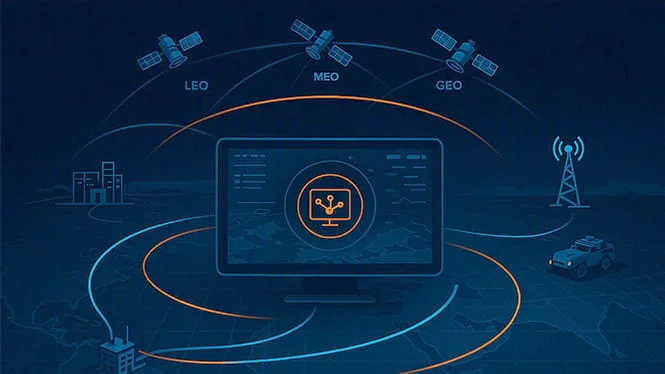
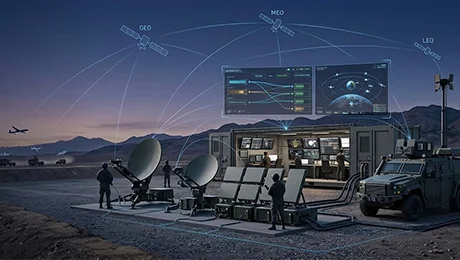
Whether operating across GEO, MEO, and LEO satellite networks, terrestrial fiber, or 4G/5G infrastructure, Hughes enables organizations to maintain mission continuity through intelligent routing, autonomous failover, and policy-driven network orchestration.
Network Resiliency Cannot Be Optional
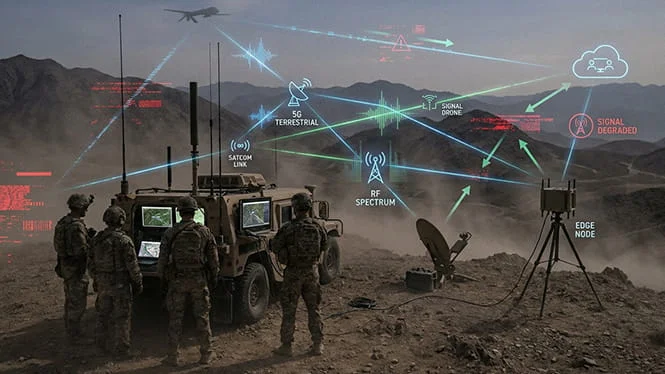
Modern organizations operate in increasingly complex environments where communications may be disrupted by:
- Congested or degraded networks
- Cyber threats
- Loss of centralized command
- Dynamic operational conditions
- Multiple transport providers and technologies
Mission success depends on maintaining connectivity regardless of network conditions. Hughes Resilient Connectivity provides the visibility, intelligence, security, and automation needed to keep critical operations online.
A Three-Tier Architecture for Continuous Operations
Hughes combines three complementary technologies into a unified resiliency framework:
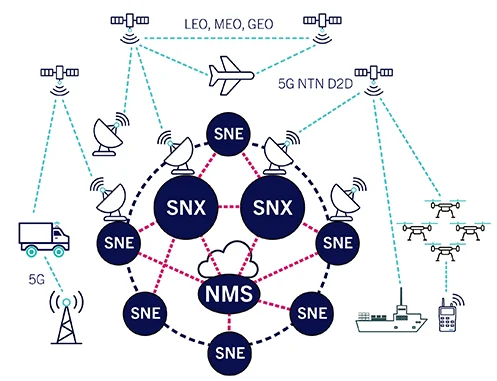
- Network Management System (NMS) – Enterprise-level visibility, orchestration, and policy management. More Information.
- Smart Network Exchange (SNX) – Secure transport fabric enabling policy-driven routing across heterogeneous networks.
- Smart Network Edge (SNE) – Tactical-edge intelligence providing autonomous operation and local decision-making.
Together, these components create end-to-end resiliency from the core to the operational edge.
Key Benefits
Maintain Mission Effectiveness
Deterministic network behavior improves operational outcomes.

Autonomous Failover
Reduce operational risk with intelligent traffic steering and automated failover capabilities.

Core-to-Edge Visibility
Gain situational awareness across cyber, RF, and network domains.

Multi-Transport Agility
Operate seamlessly across GEO, MEO, LEO, fiber, and 4G/5G networks.

Secure Operations
Incorporate Zero Trust Access, next-generation firewall services, and CSfC-based security approaches.

Future-Ready Architecture
Rapidly integrate emerging transport technologies as mission requirements evolve.
Enterprise-Level Orchestration
The Hughes Network Management System provides centralized control and visibility across the entire communications ecosystem. Network operators can define priorities, allocate resources, enforce PACE strategies, and monitor network health in real time.
Highlights:
- Global asset monitoring
- Dynamic resource planning
- FCAPS analytics
- RF and cyber situational awareness
- Enterprise system integration
Resilient Transport Fabric
The Smart Network Exchange creates a secure, transport-agnostic mesh connecting users, networks, and mission locations. Intelligent routing policies continuously optimize traffic flow based on network conditions and mission priorities.
Highlights:
- Mesh networking
- QoS enforcement
- Policy-based routing
- Integrated security
- Heterogeneous network interoperability
Autonomous Edge Operations
The Smart Network Edge provides local awareness and independent decision-making even when centralized management is unavailable. This ensures mission continuity in highly dynamic or contested environments.
Highlights:
- Link monitoring
- Application prioritization
- Autonomous operations
- Transport awareness
- Secure policy enforcement
Use Cases

Defense Operations
Enable resilient communications across tactical and strategic environments.

Government Agencies
Maintain operational continuity and secure connectivity during critical missions.

Emergency Response
Support disaster recovery and emergency communications when infrastructure is degraded.

Critical Infrastructure
Protect operational technology and maintain network availability across dispersed locations.

Energy & Utilities
Maintain reliable connectivity to remote facilities and field operations.
Responding to the Needs for Resilient Networks
Since 2017, Hughes has been working with DoD to develop the ultimate SATCOM flexibility. Now available for wider use, TMA can be incorporated into any terrestrial or aeronautical SATCOM solution for the DoD and critical infrastructure.