
Military Service Members Require Resilient Connectivity for Small UAS
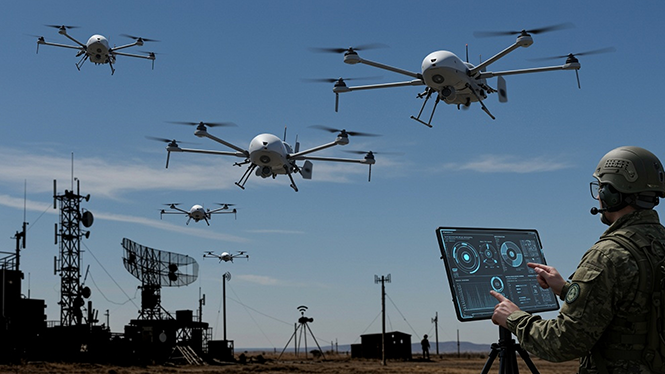
The Hughes Defense team recently traveled to meet military users at conferences across the United States and discuss innovative drone capabilities that can meet military requirements for resilience, scale, and cost. The U.S. Air Force, U.S. Army, and Special Operations all explained their need to enhance operations by using small, unmanned aircraft systems (sUAS) that can stay connected no matter what the mission or environment.
For example, the U.S. Army Aviation Warfighting Summit in Nashville, TN, brought military users and industry leaders together to strategize how to place trusted, cutting-edge drone technology in the hands of soldiers as quickly as possible. Achieving this goal is critical to mission success as small UASs can transform mission operations by using AI-enabled capabilities for agile targeting and rapid engagement on the battlefield. The Hughes team heard from many Department of War services, in addition to Army aviators/controllers, that they need low-cost, quickly deployable solutions to increase U.S. competitiveness.
Drone Manufacturers and Military Users Discussed Resilience
Drone manufacturers attended the Army Aviation Conference, as well as the 2026 Xponential Conference, NAV-AIR-SEA, and the Special Operations Forces Week, to better understand the mission and technology requirements for these sUAS. This includes being able to deploy thousands of small platforms that will provide resilience in contested, denied, and degraded communications environments. For this resilience, the platforms need low-cost, small and light-weight communications solutions that ensure reliable Beyond Visual Line of Sight (BVLoS) connectivity, at cost points that leverage economies of scale. Long-range communications can leverage multi-channel capabilities to provide much-needed reliability for true drone dominance at the tactical edge.
Addressing the Constraints of Today’s Communications for sUAS
During meetings with military users and drone manufacturers, the Hughes team learned more details about the considerable constraints that drones may experience. Line of site and fiber spools can only get you so far. Resilience means multi-channel, providing alternative connectivity when any one channel experiences limited performance or vulnerability. Every communications method has its weakness (jamming, range, detection, bandwidth). No single solution fits every situation.
To overcome these vulnerabilities and achieve critical autonomy at the edge, sUAS needs dynamic communication systems that ensure uninterrupted connectivity. This includes leveraging artificial intelligence like embedded AI to enable single controllers to direct entire swarms of UASs and provide local perception, prioritization, and decision support. Our team knows that long-range connectivity will play an important role as soon as these platforms are deployed. This will be true especially as they move between different fields of operation and in all types of environments to deliver extended range effects.
Resilient, Low-Cost Connectivity Solutions Using AI-Enabled, Multi-Channel Communications
Hughes has deep expertise in delivering flexible, intelligent communication to airborne platforms. Communications capabilities like these will play an essential role in supporting Drone Dominance by providing multiple channels, including cellular/5G, LEO/MEO/GEO SATCOM, Direct-to-Device (D2D), LOS, and Mesh. Our innovative hardware and AI-enabled software solutions focus on low SWaP-C for group 1-3 UASs to provide seamless switching between channels, along with the management and monitoring tools to implement resilient communication for thousands of platforms. As small, Unmanned Aircraft Systems become the future of combat, using multiple transport channels such as these can deliver the maximum resiliency and dependability the drone warfighter needs.
Learn more about how we are making drone command and control and communications more resilient at: Hughes Resilient Connectivity for Unmanned Aerial Vehicles