
When Networks Heal Themselves: The Business Impact of Autonomous Recovery at Scale
For organizations operating hundreds or thousands of distributed locations, network disruptions are inevitable. The real question isn’t whether an outage will occur, it’s how quickly the business can recover and how much operational effort is required to restore service.
Traditionally, network recovery starts with a support ticket. A store manager notices a problem. An employee contacts the help desk. Support personnel begin troubleshooting. A technician may need to remotely access equipment, guide someone onsite through a reboot procedure, or dispatch additional support resources. Even when secondary connectivity keeps the location operational, valuable time and labor are consumed restoring the preferred connection.
Multiply that process across thousands of locations, and what appears to be a routine troubleshooting task quickly becomes a significant operational burden. Today, enterprises are increasingly looking beyond monitoring and alerting toward a new objective: autonomous network operations.
Moving Beyond Detection to Action
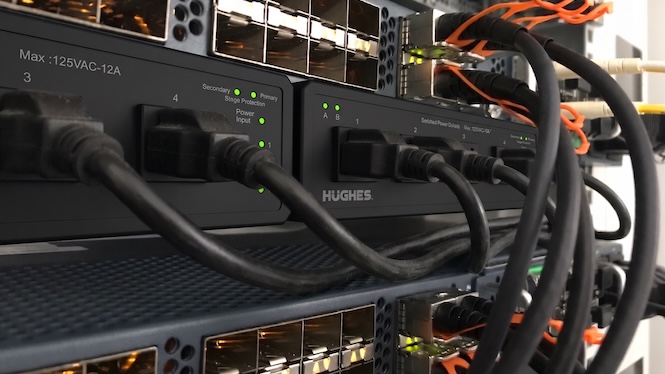
Most network monitoring tools can identify when something is wrong. Far fewer can resolve the issue without human intervention. The Hughes Active Power Edge was designed to bridge that gap. By continuously monitoring network connectivity and critical devices, the Active Power Edge can automatically initiate recovery actions when issues are detected.
Rather than waiting for a support call or manual intervention, the platform can automatically restart affected equipment or restore network transports to help recover service and maintain continuity. The result is a self-healing approach to network operations that reduces reliance on manual troubleshooting while helping maintain uptime across distributed environments.
What Autonomous Recovery Looks Like in Practice
For one internal study representing approximately 6,000 enterprise deployments nationwide, Hughes implemented and closely monitored an automated transport recovery capability powered by the Active Power Edge. When a transport outage is detected, the system automatically initiates a recovery action without requiring helpdesk involvement or onsite intervention.
The results demonstrate the value of automation at scale:
- Approximately 1,400 transport recovery events are automated each month.
- Average automated recovery time is less than 9 minutes.
- Recovery actions occur without manual reset procedures, support calls, or any human intervention.
- Consistent, repeatable remediation is delivered across thousands of sites, month over month
- Zero-touch recovery reduces dependence on technician involvement.
While individual interruptions may seem minor, the cumulative operational impact can be substantial when organizations manage hundreds or thousands of remote locations.
The Real Business Benefit: Freeing IT Teams to Focus Elsewhere
Network teams didn’t sign up to spend their days coordinating equipment reboots. Yet manual remediation often consumes valuable time that could otherwise be spent on strategic initiatives, modernization projects, security improvements, or customer-facing innovation.
Historically, a transport recovery event could require 10 to 20 minutes of troubleshooting and recovery activity. Across approximately 1,400 automated recoveries per month, automation can eliminate hundreds of hours of support effort monthly and thousands of hours annually.
The value extends beyond simple labor savings. IT teams gain:
- Fewer support escalations
- Reduced help desk workload
- More predictable operations
- Faster issue resolution
- Greater consistency across locations
In other words, automation helps shift resources from reactive problem-solving to higher-value business priorities.
Reliability Is More Than Uptime
Business leaders often think about downtime in terms of whether a location is online or offline, but the reality is more nuanced. A network issue can impact transactions, employee productivity, customer experiences, digital applications, and business processes long before a site is fully disconnected. Even brief disruptions create friction that accumulates across a large organization.
By automatically detecting issues and initiating recovery actions, the Active Power Edge helps reduce outage duration and improve overall network resilience. Consistent recovery performance helps maintain application availability and supports business continuity across geographically dispersed operations. For industries such as retail, restaurants, financial services, healthcare, energy, and convenience retail, those improvements can translate directly into stronger operational performance and a better experience for employees and customers alike.
Building the Foundation for Autonomous Operations
Autonomous recovery represents more than a single feature. It’s part of a broader evolution in network management. As organizations continue adopting AIOps, predictive analytics, and automated workflows, the ability to identify, diagnose, and remediate common issues without human intervention will become increasingly important.
The Active Power Edge contributes to that framework by combining intelligent device monitoring, automated response capabilities, centralized visibility through the HughesON Portal, and long-term reporting that helps uncover recurring issues before they become chronic problems. The result is a smarter, more resilient network environment that can scale as business requirements grow.
From Reactive Operations to Self-Healing Networks
Organizations with distributed networks have spent years investing in faster connectivity, better monitoring tools, and improved visibility. The next frontier is reducing the amount of human effort required to keep those networks operating.
Autonomous recovery helps organizations reduce downtime, eliminate unnecessary support interactions, and improve operational efficiency at scale. Most importantly, it helps ensure that employees stay focused on serving customers instead of resolving technology problems.
That’s the promise of self-healing networks—and why automation is becoming an increasingly important component of modern managed network services.
Learn more about the Active Power Edge and how it can keep critical business components online.